

Sigma notation: Definition, formula, and examples

The sigma notation is frequently used in mathematics and statistics to perform various algebraic and central tendencies tasks. It is also used to avoid larger expression problems. The summation has a wide number of uses in our daily life.
It is used to find the sum of the same or different kinds of terms to get the summed result. Such as, if you have taken 18 packs of juice and the price of 1 pack is 200, then you have to take the sum of 200 about 18 times.
In this post, we will learn all the basic concepts of summation notation along with solved examples.
(adsbygoogle = window.adsbygoogle || []).push({});
What is sigma notation?
Sigma notation is a Greek notation that is used to calculate the addition of many numbers. It is widely used in algebra and statistics to meet the needs of several branches of these subjects. It is also known as the summation notation.
It is denoted by a “∑” symbol with the initial and final terms of the variable. The starting and the final values indicate that the values should be substituted from the initial to final such as if the initial value is 1 and the final value is 10 then you have to substitute the values:
1, 2, 3, 4, 5, 6, 7, 8, 9, 10 in the function. such as

· In the above expression, the “∑” is the notation of summation.
· “Mi” is the group of number or a summation function in which the values from initial to final has to be substituted.
· “i = 1” is the initial term of the function.
· “n” is the final term.
The sum of the group or list of numbers can be calculated either by using simple summation or notation of summation known as sigma notation.
(adsbygoogle = window.adsbygoogle || []).push({});
1. Simple summation
To add the list of numbers directly without a function refers to the simple summation in which the group or a list of numbers can be summed by long addition. Such as, if you have to determine the sum of the first 10 whole numbers then use a simple summation method and apply the plus sign between the consecutive numbers.
Sum of first 10 whole numbers = 0 + 1 + 2 + 3 + 4 + 5 + 6 + 7 + 8 + 9
Sum of first 10 whole numbers = 45
2. Summation (sigma) notation
There is another method of finding the sum of the list of numbers is known as the sigma notation method is used in which a list of numbers can be written in the form of a function by taking the first and last term of the series.
Let us take an example of finding the sum of the first 10 multiples of 3. First of all, make a function of multiples of 3 and apply the initial and final value. Then apply the limiting values one by one with the addition sign among them.

Use a sigma notation calculator to get the result of simple summation or sigma notation with steps in a fraction of seconds.
Laws of summation notation
Here are some well-known laws of summation notation.
1. Constant Law
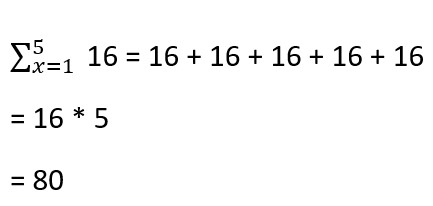
If you have to find the sum of a constant value up to several times then the constant law is used. According to this law, you have to write the constant term up to n times and multiply the constant term with the nth value of the list to get the summed result.
The general formula for this law of summation notation is:

Where k is any constant.
Example

Solution
2. Sum Law
The sum law of summation is used when there are two or more functions present with the plus sign between them. according to this law of summation, the notation of summation is applied to each function separately.
The general formula of this law of summation is:

Example
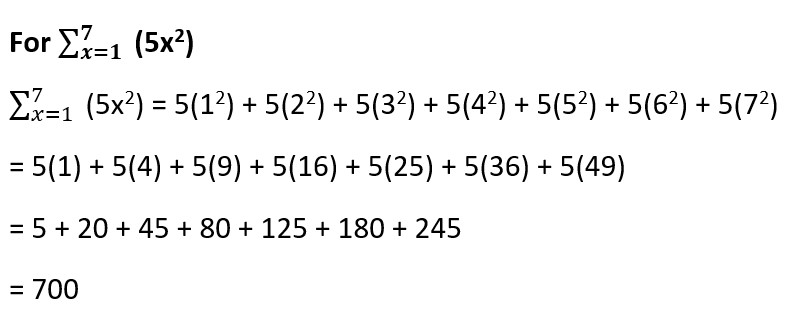
Find the sum of 5x2 + 3x + 2 if the initial value of the summation notation is 1 and the final value is 7.
Solution
Step 1: Take the given function and apply the sigma notation to it.

Step 2: Use the sum law of summation and apply the notation of summation to each function separately.
Step 3: Now determine the sum of each function one by one.
Step 4: Now place the above-calculated values in the expression.
(adsbygoogle = window.adsbygoogle || []).push({});
3. Difference Law
The difference law of summation is used when there are two or more functions present with a minus sign between them. According to this law of summation, the notation of summation is applied to each function separately.
The general formula of this law of summation is:
Example
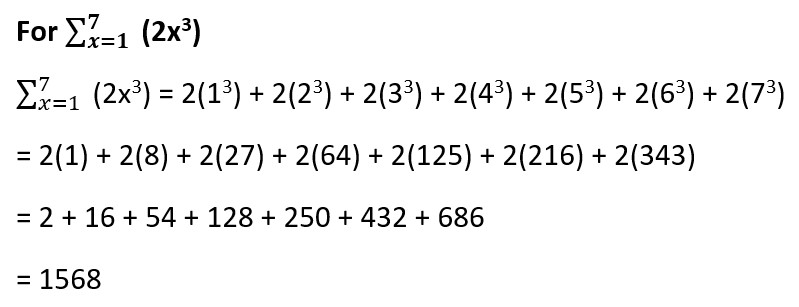
Find the sum of 2x3 – 5x – 7 if the initial value of the summation notation is 1 and the final value is 7.
Solution
Step 1: Take the given function and apply the sigma notation to it.
Step 2: Use the difference law of summation and apply the notation of summation to each function separately.
Step 3: Now determine the sum of each function one by one.
Step 4: Now place the above-calculated values in the expression.
(adsbygoogle = window.adsbygoogle || []).push({});
Conclusion
In this post, we have covered all the concepts of summation notation along with the definition, kinds, laws, and solved examples. Now after reading the above article, you can solve any problem with sigma notation manually