
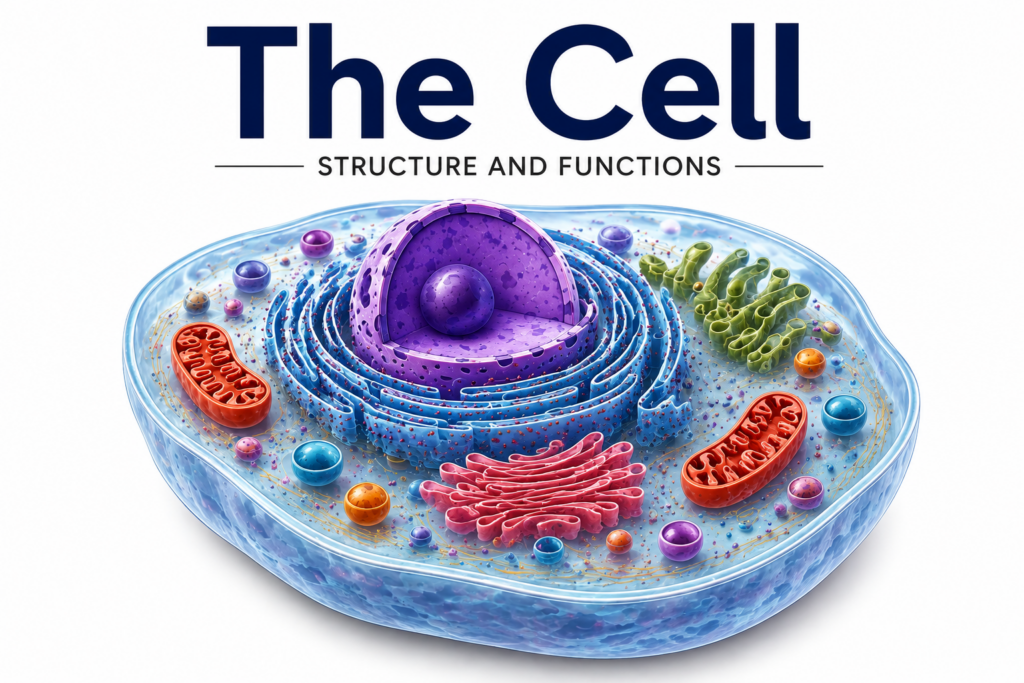
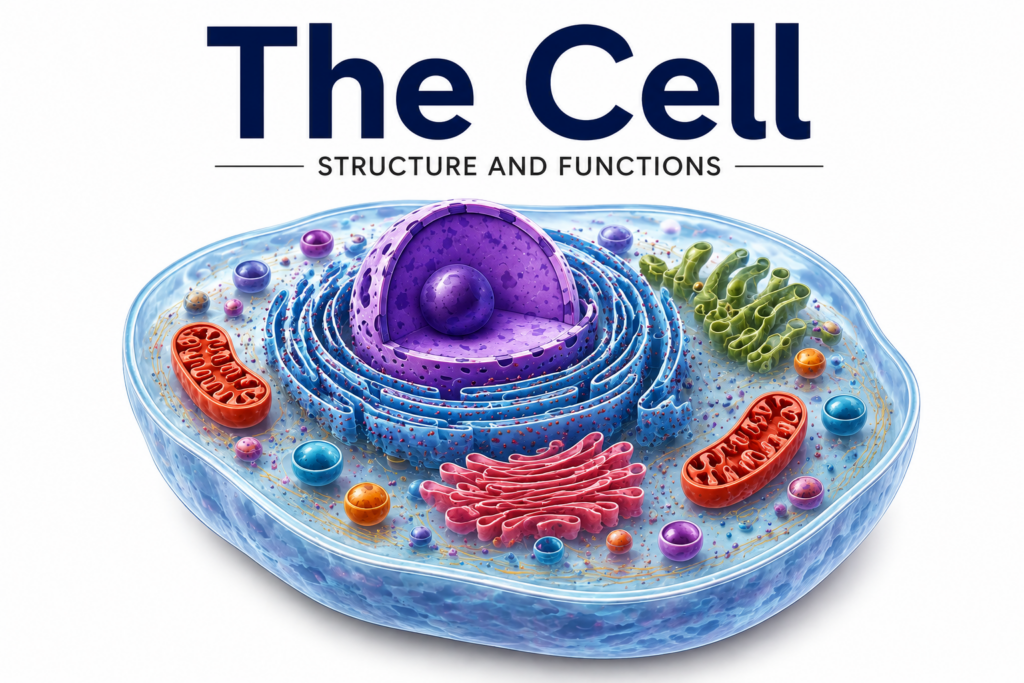
The Cell
The Cell – Structure, Types, Organelles, Functions, Transport & Cell Division
The cell is the basic structural and functional unit of life. Every living organism is made of one or more cells, and all essential life processes occur within cells.
1. Development of Cell Biology
2. Cell Theory
- All living organisms are composed of one or more cells.
- The cell is the basic structural and functional unit of life.
- All cells arise from pre-existing cells.
3. Types of Cells
Cells can be classified in different ways according to their structure, organisation and function. The most important structural classification is into prokaryotic and eukaryotic cells. Multicellular organisms also contain many specialised cell types adapted to particular functions.
Definition: A prokaryotic cell is a relatively simple cell that does not have a membrane-bound nucleus. Its genetic material lies in a region called the nucleoid.
Structure: It generally has a plasma membrane, cytoplasm, ribosomes and genetic material. Many bacteria also possess a cell wall, capsule, pili or flagellum.
Examples: Bacteria and cyanobacteria.
Definition: A eukaryotic cell is a more complex cell containing a membrane-bound nucleus and specialised membrane-bound organelles.
Structure: It contains a plasma membrane, cytoplasm, nucleus and organelles such as mitochondria, endoplasmic reticulum and Golgi apparatus. Plant cells additionally contain a cell wall and plastids.
Examples: Plant, animal, fungal and protist cells.
Major Cell Types in Multicellular Organisms
In a multicellular organism, cells become specialised through cell differentiation. Their shape and internal structure are adapted to perform particular functions.
Definition: A eukaryotic cell forming the basic structural and functional unit of plants.
Characteristics: Usually has a cellulose cell wall, chloroplasts in photosynthetic tissues and a large central vacuole.
Function: Performs plant life processes such as photosynthesis, respiration, transport, storage and growth.
Definition: A eukaryotic cell forming the basic structural and functional unit of animals.
Characteristics: Has a plasma membrane but no cell wall or chloroplasts. Vacuoles are generally small and less prominent.
Function: Specialised animal cells perform functions such as movement, communication, protection, secretion and transport.
Definition: A unicellular prokaryotic cell belonging to the domain Bacteria.
Characteristics: Usually has a cell wall, plasma membrane, cytoplasm, ribosomes and nucleoid DNA; some have capsules, pili or flagella.
Function: Carries out nutrition, respiration, growth and reproduction within a single cell.
Definition: A cell whose structure and internal organisation are adapted to perform a particular function efficiently.
Examples: Red blood cells, nerve cells, muscle cells and root hair cells.
Function: Specialisation allows cells to perform particular tasks efficiently and enables division of labour in multicellular organisms.
Prokaryotic Cell vs Eukaryotic Cell
| Feature | Prokaryotic Cell | Eukaryotic Cell |
|---|---|---|
| Nucleus | No true membrane-bound nucleus; DNA is present in the nucleoid. | True nucleus enclosed by a nuclear membrane. |
| Size | Generally smaller, about 0.1–5 µm in many bacteria. | Generally larger, often about 10–100 µm. |
| Cell organisation | Simple and relatively less compartmentalised. | Complex and highly compartmentalised. |
| Membrane-bound organelles | Absent. | Present, including mitochondria and Golgi apparatus. |
| Genetic material | Usually a main circular chromosome; plasmids may also occur. | Usually several linear chromosomes inside the nucleus. |
| Ribosomes | Present; generally smaller in size. | Present; cytoplasmic ribosomes are generally larger. |
| Cell wall | Common in bacteria; composition differs from plant cell walls. | Present in plants and fungi, absent in animal cells. |
| Examples | Bacteria and cyanobacteria. | Plants, animals, fungi and protists. |
4. Plant Cell and Animal Cell
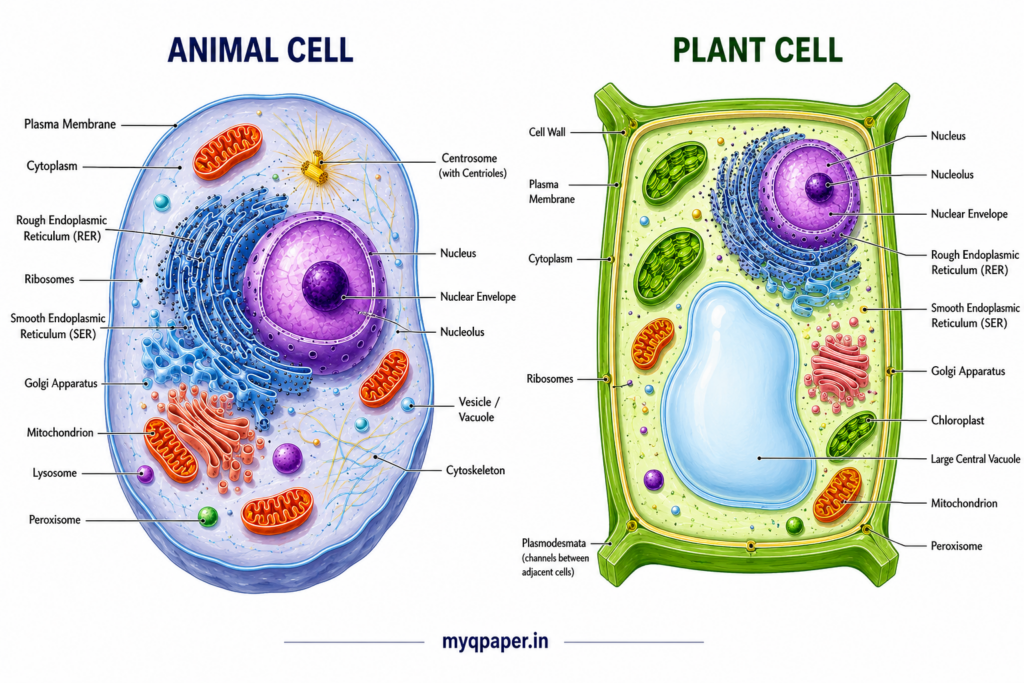
Both plant and animal cells are eukaryotic, so they contain a true nucleus and membrane-bound organelles. Their structures differ because plants and animals have different ways of obtaining food, providing support and responding to their surroundings.
Definition: The basic structural and functional unit of a plant.
Distinctive features: Cellulose cell wall, plastids such as chloroplasts in photosynthetic cells, and usually a large central vacuole.
Importance: The cell wall provides support, chloroplasts enable photosynthesis, and the large vacuole helps maintain turgor and stores substances.
Definition: The basic structural and functional unit of an animal.
Distinctive features: Plasma membrane without a cell wall; no chloroplasts; vacuoles are generally small and less prominent.
Importance: The flexible cell boundary and specialised organelles allow animal cells to perform diverse functions in tissues and organs.
| Feature | Plant Cell | Animal Cell |
|---|---|---|
| Cell wall | Present; mainly cellulose. | Absent. |
| Plasma membrane | Present, beneath the cell wall. | Present as the outer boundary. |
| Chloroplasts | Present in photosynthetic cells. | Absent. |
| Vacuole | Usually one large central vacuole. | Usually small and less prominent. |
| Shape | Often more fixed because of the cell wall. | Usually more flexible and variable. |
| Centrioles | Generally absent in higher plant cells. | Typically present in the centrosome. |
| Food reserve | Commonly starch. | Commonly glycogen. |
5. Cell Organelles and Their Functions
Cell organelles are specialised structures within the cell. Each has a particular structure and function, and together they maintain the organisation and activities of the cell.
6. Movement of Substances Across the Cell Membrane
Diffusion
The net movement of particles from a region of higher concentration to lower concentration until they become more evenly distributed. It does not require cellular energy.
Osmosis
The movement of water molecules through a selectively permeable membrane from a region of higher water concentration (dilute solution) to lower water concentration (more concentrated solution).
Active Transport
Movement of substances against the concentration gradient, usually from lower concentration to higher concentration, using cellular energy, generally ATP, and specific transport proteins.
| Feature | Diffusion | Osmosis | Active Transport |
|---|---|---|---|
| Substance | Solute/particle or gas | Water | Specific ions or molecules |
| Direction | High → low concentration | High water → low water concentration | Low → high concentration |
| Energy | Not required | Not required | Required |
| Membrane | May occur with or without a membrane | Requires a selectively permeable membrane | Requires membrane transport proteins |
Osmotic Conditions
Isotonic solution: Water enters and leaves at approximately equal rates, so there is no net movement of water.
7. Genetic Material: DNA, Genes and Chromosomes
- DNA: Molecule that stores hereditary information in cells.
- Gene: A functional unit of heredity; a DNA sequence that contributes to a particular functional product or trait.
- Chromosome: A DNA-protein structure carrying many genes. During cell division, chromosomes become highly condensed and visible.
- Chromatin: DNA associated with proteins in the nucleus; it becomes more condensed to form visible chromosomes during division.
8. Cell Division
Cell division produces new cells. It is essential for growth, repair, replacement and reproduction.
Mitosis
Mitosis produces two genetically similar daughter cells with the same chromosome number as the parent cell. It is important for growth, tissue repair and asexual reproduction in many organisms.
Meiosis
Meiosis is a specialised division that produces haploid cells, reducing the chromosome number by half. It is important in sexual reproduction and creates genetic variation through processes such as crossing over and independent assortment.
| Feature | Mitosis | Meiosis |
|---|---|---|
| Number of divisions | One | Two successive divisions |
| Daughter cells | Usually 2 | Usually 4 |
| Chromosome number | Maintained | Reduced by half |
| Genetic similarity | Usually genetically similar to parent and each other | Genetically varied |
| Main role | Growth, repair, replacement, asexual reproduction | Formation of reproductive cells and genetic variation |
9. Cell Specialisation
In multicellular organisms, cells become specialised for particular functions. This process is called cell differentiation.
- Red blood cells: Specialised for oxygen transport.
- Nerve cells: Specialised for rapid transmission of electrical signals.
- Root hair cells: Specialised for absorption of water and mineral ions.
- Muscle cells: Specialised for contraction and movement.
10. Essential Definitions
Cell: Basic structural and functional unit of life.
Organelle: Specialised structure within a cell performing a particular function.
Selective permeability: Property of a membrane that allows some substances to cross more readily than others.
Osmosis: Movement of water through a selectively permeable membrane down its water concentration gradient.
Plasmolysis: Shrinkage of the cell contents away from the cell wall when a plant cell loses water in a hypertonic medium.
Cell theory: The basic principles stating that organisms are made of cells, cells are the basic unit of life, and cells arise from pre-existing cells.
Cell division: Process by which a parent cell divides to form new cells.
11. Did You Know?
Some interesting facts make the basic ideas of cell biology easier to remember.
The human body contains trillions of cells, working together as specialised tissues and organs. Although cells differ greatly in shape and function, they share fundamental features such as genetic material, a boundary membrane and chemical processes needed for life.